
“How adventure sport participants make decisions in very challenging, ever changing natural environments… has implications for how people make decisions in finance, medicine, and other fields.”
— Audun Hetland (Stringer 2023), psychologist at The Arctic University of Norway
|

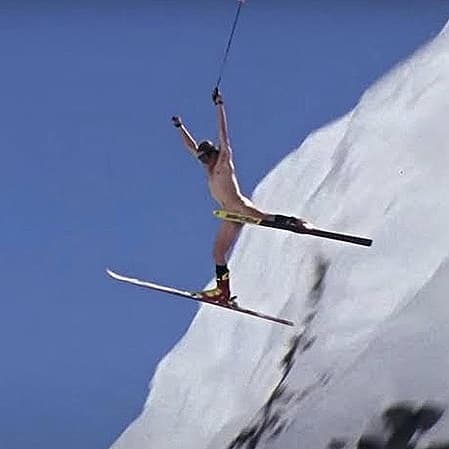
Shane McConkey, RIP
Seeking Adventure
I’m an explorer and I’m working on a book about people who are drawn to do things beyond what’s safe and familiar. The book will be about the motivations and rewards that drive alpinists, BASE jumpers, and backcountry skiers. These are three sports that have expanded our notion of what’s possible and, in the process, resulted in a lot of dead alpinists, jumpers, and skiers.
A word of definition is in order. All of these sports have evolved substantially over the last 100 years and the way I’m looking at them is not the only perspective. What they all have in common is that they involve largely personal experiences that are not competitive, not easily measured, not easily described, not easily observed or experienced, and they do not involve professionals. There have been efforts to make, describe, or present each as competitive and spectacular. There are some people who are funded and make a living at doing these things, but they are the exception.
Alpinists climb dangerous mountains with minimal gear in unpredictable conditions. They climb in groups of two or three and sometimes alone. BASE jumpers jump off natural or artificial structures spending less than a minute in free fall before deploying a parachute. They usually pursue their sport in small groups unless they’re attempting something that’s prohibited, in which case the jump alone. Backcountry skiers ski on ungroomed, unpredictable, and often unexplored mountainsides after either skiing, walking, or climbing to the top, or being lifted by a helicopter.
Alpinists are injured by falls, avalanches, and severe weather. BASE jumpers either hit things while they’re descending or when they reach the ground. Backcountry skiers are injured in falls and avalanches.
There are big differences in the attitudes, investments, and rewards these sports offer. There are also dramatic difference in the duration of the experience as climbs take days, a ski slope take minutes, and BASE jumps can take as little as a few seconds.
Not “Because It’s There”
“Because it’s there,” George Mallory’s famous answer to the question of why he wanted to climb Mt. Everest, is taken to be deep and meaningful by those who have no interest in climbing, but it was a flippant response that has no substance. It’s very British to be credulous in accordance with the social rank of whom you’re listening to. The most we can say is that Mallory’s answer was as superficial as the question.
I’ve been interviewing people who do these things, reading academic studies about extreme sports and the memoirs of introspective practitioners. The mindsets of these people have much less in common than you might think but, once you think beyond simply taking risks, this makes sense.
“These people are not reckless… Risk is not the main motivation but rather something that pushes them to focus and achieve mastery in their activities.”
— Erik Monasterio, MD (2019) Christchurch School of Medicine, New Zealand
It will take me quite a bit of time and many words to explore the question of why people do these things. The more I read, the more I appreciate how much has already been said, and how little I might have to add. I’ve gradually been led to take a different tack.
I want to explore what these sports have in common with things that normal people do, which is take risks, seek exuberance, creativity, reward, and generally advance our world view. The risks and rewards are obvious, and while they make for exciting stories they don’t explain anything. I’m most interested in the question of how we expand our thinking, and that invites the question of what real change these sports offer, if they offer any.
“One kayaker reported that ‘going with the flow and learning that in a river you have to have a plan B, C, and D, you might get to plan D and realize that doesn’t work either… and that (you need the) ability to be really flexible and understand that sometimes there are bigger forces at play.”’
— Susan Houge Mackenzie, University of Otago, New Zealand (Boudreau 2022)
Ologists Are Just Ogelers
Intellectuals consider these behaviors from the perspectives of psychology or sociology. The psychologists explore what a person gains, while the sociologists explore what drives groups of people to these pursuits. These two groups of intellectuals pass each other largely unnoticed. One group thinks motivation is internal, the other external. Maintaining this separation is an academic imperative.
The memoirs explore a bit of both, and those I’ve interviewed talk about their states of mind from many perspectives. They reveal all sorts of obvious and hidden motivations. After all that I’ve heard, I feel I’m at a circus watching the strong man, the acrobats, the lion tamers, and the clowns hoping to see what they have in common.
From one perspective this goal seems ridiculous, from another it seems obvious, and from a third point of view it seems pointless. So, rather than try to explain these behaviors from some kind of sanctimonious plateau of greater knowledge, the idea I’ll develop is what lessons are being taught, what one has to gain by doing them, and when a person should stop doing these things. That begs the question of whether these pursuits are just repetitious exhilaration, or whether we’re advancing beyond sets of narrow skills.
Here’s the postage stamp version of each of these pursuits. Alpinists are working to control their world. BASE jumpers are working to achieve exhilaration. Back country skiers are adding greater rhythm in their lives. In short, these people are engaged in exaggerated pursuits aimed to achieve the same things we all aspire to.
“These experiences tap into what the senses and body are capable of and can affect the way people see the world… (making one) feel less constrained by an artificial environment, and learn(ing) that fear is not a bad emotion but rather information that requires attention to reach their potential.”
— Eric Brymer (Stringer 2023), Australian College of Applied Psychology, Brisbane
Pay No Attention to Explanations
I’m advancing three points of view. The first is that if you don’t know what you’re trying to achieve, then you won’t recognize it when you achieve it. Second, once you understand what you might achieve, you must redirect yourself and refine your goals. And third, the deeper skills and understanding you can achieve are valuable and rare, and you should make use of them in your life.
At some point I feel a person who gains wisdom is obliged to share, teach, or model what they’ve learned for the advancement of others. I’m not talking about the means of the sport, like how to climb or jump or ski, but the personal achievements that result from it. At some point, I believe, a person should move beyond the self-centered pursuit of skill, celebrity, distinction, and personal perfection, to the leadership role of modeling, inspiring, and applying yourself to the world.
In doing this, a person finds greater purpose and creates a less spectacular but more meaningful story. This is what people who pursue sports rarely talk about, and the spectators, voyeurs, and arm chair enthusiasts would not understand. We want to disentangle the stick that compels people from the carrot that attracts them. They are opposing but complementary drives.
Attraction, Compulsion, Addiction
When we talk about addictions we always focus on the negative nature of the compulsion. We say that normal people can safely indulge, but addicts cannot control themselves. We’ve accepted this story because nonaddicts don’t have a problem while addicts do. This story is false.
It makes more sense to see compulsion as an incompletely satisfied desire. The addict gets the same reward as the nonaddict, they just are not satisfied with what they get, and they’re undeterred by the punishments that result from going further. But in telling the addict that their desire is unreasonable, we deny them the need to learn through experience. We attempt to substitute intellectual understanding for experiential learning. Such an arm’s length approach to learning fails everywhere; learning requires risk and engagement.
For someone addicted to an experience, an intellectual understanding of it is worthless since it offers neither sensation nor emotion. Those who are not addicted may think that an intellectualizing is useful, but have no need to understand the compulsion because they don’t have it.
I suspect most people will object to my equating a compelling desire to improve one’s performance with substance addiction. If you feel this way, then you are in denial. You are trying to maintain a dichotomy between negative, stigmatized behavior and positive, celebrated attitudes when both are rooted in compulsion.
Of Chemistry and Consciousness
There will still be those who insist that substance addiction is chemical while a commitment to becoming more skilled is a conscious, mental choice. This is untrue. Most chemical addictions are strongly mental. A person who has decided to stop smoking will stop smoking. A person who believes they could stop taking risks but decides to continue is not making a conscious mental choice, they’re acting by habit. Both of these people have an addictive mindset.
Alcoholics Anonymous celebrates abstinence and denies that one could simply taper one’s drinking down to a sustainable level. It makes much better press to say, “I’ve stopped drinking, and you can too,” than to say, “I drink less and now I’m okay with it… and you’ll also be okay if you drink less.”
Do we ever celebrate an athlete, power broker, mogul, or movie star who says, “I don’t need to go to such extremes. I’ve found I can be happy at a moderate level.” We don’t reward such behavior because watching these people is a spectator sport. We want their stories to be spectacular. We want them to be successful in accordance with our dreams, or go up in flames.
We like phenomenal success and spectacular failure. Only the aged public accepts diminished performance with age. Younger spectators write off as infirm and over the hill anyone who ages out of the limelight.
The substance addict is driven by a need in the same way as the high performance worker. They are striving for a reward and feel emotionally deprived without it. The needs and consequences are different, as there are all manner of needs, but there will always be a need behind every compulsion.
The solution to substance addiction is similar to wealth, performance, excitement, affirmation, or celebrity addiction. It is to understand the need, find a sustainable way to satisfy it, and move on to a higher spiritual level of awareness. To do this a person must separate themselves from their social contract.
If You Don’t Know What’s on the Menu, You Are
It is clear that one’s audience neither knows, cares, nor understands what drives you. You cannot look to your audience for guidance as they are simply consumers. Those who reward you are either profiting from your efforts, or are watching the spectacle. The audience’s compulsion for spectacle fuels the athletes’ addiction for recognition even though the two never recognize or satisfy each other.
The highly paid executive’s addiction to their high salary is fueled by the perception of scarcity manifested in the attitudes of those around them, including others with high salaries. The fear of lack is more of a drive than the attraction of gain. You might think this is not the case with athletes, but it is.
High performance people mostly strive for improvement, they rarely rest in a state of fulfillment. The famous “flow state of mind” is what all athletes aim for, but they almost never achieve it. Athletes achieve the flow state to the same degree that heroin addicts find bliss, to the same extent that high wage earners feel they have sufficient earnings. The flow state, a state of complete peace, may be what people say they aim for, but it is not what high achievers are satisfied with.
Will You Take Life Seriously?
Consider creating art. The challenge for an artist is to feel fulfilled with their creation. This doesn’t mean they stop creating, but it does mean they stop feeling compelled to continually produce and be recognized.
Art is ultimately something the artist experiences. It is not the skillfulness of the execution that is satisfying, it is the personal meaning of the work. This is not always clear because some works are best appreciated only when done skillfully. But if you don’t have an audience, you can set your own values.
Consider a difficult piece of music. Such pieces are designed to work only when performed well. A skillful performance has a better effect on an audience. A performing musician who plays this sort of music is committed to deliver skillfully. This is what the product requires and the audience demands, but technical skill is not required of all music or provided by all musicians.
Drones, background music, overtone music, and ambient sounds are subtle and skillful, but need not be technically difficult. They also make different requirements of the listener.
I most enjoyed playing classical guitar when I could listen to the perfection of a few measures. I did not need the whole piece to be perfect, and I could not play the whole piece perfectly. A better musician than I would commit to a complete and flawless performance, and they would then be celebrated for it. I could not care less.
I recognized that to perfect the whole piece would mean there would be many other things I would not have time to do. Such a complete investment seemed like a waste when I could simply play a few measures and repeatedly enjoy them.
We often hear of the benefit of the child’s mind, or the beginner’s mind. At the same time, we accept the admonition that we must be skilled before we perform. In every school of skillful endeavor I’ve been told to master the basics before getting creative. This is anti-childish advice that damages the creativity and appreciation. It is just as destructive in physics as it is in skiing, music, or yoga.
You’ll Never Be Enough
You cannot first learn skill and then engage meaningfully; your engagement must be meaningful from the start or else it never will be. I have told this to several academically minded skill-hogs and I never get a response. They are too self-important to entertain the undignified suggestion that their skill is not paramount.
I have told this to teachers, telling them that the subject matter they teach is antithetical to inspiration. They are always disdainful and dismissive, but then teachers are not masters of their fields because masters know better than to attempt to teach. The adage, “those who don’t know, teach” is fundamentally true. You might learn by teaching; you don’t learn by being taught.
I cannot end this piece without taking a shot at Donald Trump. Why is it that a person of such low integrity and sub-average intelligence—his I.Q. is estimated to be between 85 and 100—can command such a following and be so destructive? The answer lies in the audience.
People like spectacle and novelty. They love being fooled whether it’s by magicians, con artists, clowns, or casinos. Donald Trump is all of those things. He’s not addicted to celebrity, he’s a master of celebrity. He is not compelled to try harder or get better, he’s most satisfied when he does the least, steals the most, violates with impunity, and robs people all at once.
Trump is the perfect psychopath not only because he enjoys making others suffer but he revels in skillessness. He has the mind of a child who enjoys painting his shit over everything. We all should aspire to such a simple and contented frame of mind.
References
Boudreau, P., Houge Mackenzie, S., and Hodge, K. (2022 Sep). “Adventure-Based Mindsets Helped Maintain Psychological Well-Being During COVID-19,“ Psychology of Sport and Exercise 62. https://www.sciencedirect.com/science/article/pii/S1469029222001133?via%3Dihub
Stringer, H. (2023 Sep 1). “Extreme Sports Can Provide Mental Health Benefits—and Reducing Errors in Risk Assessment Can Improve Safety.” American Psychological Association 54 (6). https://www.apa.org/monitor/2023/09/adventure-sports-navigating-decisions
Monasterio, E., and Cloninger, C. R. (2019 Jan 7). “Self-Transcendence in Mountaineering and BASE Jumping.” Frontiers of Psychology 9. https://doi.org/10.3389/fpsyg.2018.02686
Enter your email for a FREE 1x/month or a paid 4x/month subscription.
Click the Stream of the Subconscious button.