
Poetry “can deepen the trance, soften resistance, and help clients access forms of knowing often unavailable through literal language alone.” — Shreya Mandal (2026), hypnotherapist
|

Interoception
I’m struggling to finalize my book of hypnotic trance inductions whose purpose is to enhance internal body awareness, what’s called interoception. The book The Fantastic Territory Inside You, consists of a large number of hypnotic visualizations inspired by the observation that hypnosis can stop bleeding and cause warts to fall off. I have extended this to suggest that through hypnosis you can gain greater control of your metabolism. That is, you can exert some measure of control over the functions of your organs.
I’ve written and recorded the inductions over a period of ten years. I’m reluctant to go back and reread, rerecord, or edit these pieces because I’m not sure I can coherently reengage so many different states of mind. I have been looking for a way to break the project into smaller pieces.
A Poetry Workshop
In that regard, I enrolled in a 4-week, online course on generative poetry with the group Authors Publish (https://community.authorspublish.com/feed). The course included weekly lectures on topics of some kind, along with three weekly, small group meetings for improvisational poetry writing.
I thought this would be a chance to break down aspects of my hypnotic inductions and make each part more poetic. My idea was to take various, classical stages of a hypnotherapeutic induction and focus on those stages only, to make them into something self-contained and more effective.
By “poetry” I mean something that’s verbally evocative, interesting, and can create an altered state of mind. I thought it would be interesting to read something hypnotic to an audience who was not prepared to be hypnotized, not invested in the process but willing to engage in it. That is, I would be reading hypnotic inductions to naïve subjects who thought they were listening to poetry. Here is an example and, like all hypnotic inductions, it needs to be spoken, not read:
Beyond the House of Time
You have memories in the house of your childhood:
of the bed, from the window, down the street.
And memories of where you are now, from not long ago.
Along with bits of imaginary places you might like to be.
There is a place in the early house you rarely went,
and there are doors you rarely open, where you are now.
In your imagination, there are thin ideas far out of reach.
Bring these together to a mental place you can construct.
Let this be your true home, built from places of the heart.
Imagine a tree house, an attic room, a cabin in the woods.
A little house on a bluff, of a size that fits like clothing.
Close your eyes and be there in some real way
of touch, or sound. Smell the air. See the light.
It’s a dream you know isn’t real, but ultimately it is real.
Settle in, relax, descend in time and mind… in real life.
There is a door, a drawer, a curtain, or a window,
It’s been such a long time. Open it now.
It’s more than a passage to another place;
it’s a gateway to another dimension.
A deck, a pillowed chair beside a table.
A window view to parts of sky and textured trees.
Reality starts in our imaginations.
We see few details.
Be the dream and realize it.
Germinate this seed, this seedling’s open case.
Don’t question the sprout;
It’s delicate. Allow it.
Release your hold and go through,
floating, footless, groundless, air-like,
moving through space and into the distance.
Trust your vision.
You really can meet your ancestors.
You really can meet your descendants.
Relax… breathe… patience… timeless.
You may wait… all your life, but they will come.
If you’d like to make your life more creative or engaging, schedule a free call…
Imposter Syndrome
Imposter syndrome is the feeling that you’re presenting yourself falsely. That is to say, that you do not have the ability that you claim while others accept who you pretend to be. I avoided imposter syndrome by never claiming I was a poet. In fact, I dislike poetry and have no attraction to the literary form. I am not an imposter poet because I’m not a poet. You might say I am simply a fraud, but I don’t care!
Hypnosis is different from poetry because its goal is therapeutic rather than aesthetic. The aesthetic appeal of the induction, if there is any, is incidental. It’s the verbal forms that poetry and inductions have in common.
“Poetry and advanced clinical hypnotherapy meet in their shared reliance on rhythm, metaphor, and the transformative potential of language.” — Shreya Mandal (2026)
Hypnotic Structures
The course was presented by two people who might have been poets, I don’t know. They talked about the community, industry, and art forms of poetry, things in which I have no interest and did not listen to or attend. I was interested in creating quick, hypnotic pieces and applying them to my classmates, most of whom were elderly women with no other interests.
Some audience is better than no audience, and these people, as participants, were obliged to express their opinions. That made this a unique opportunity for me to combine aesthetics with subtle manipulation and extract some unbiased opinions.
The basic form of a hypnotic induction is relaxation, dissociation, evocation, suggestion, deepening, integration, and recovery. I’ve invented the following descriptions of each of these phases.
- Relaxation: remove the defensive attitude to interaction that normally dominates our experience.
- Dissociation: weaken the listeners self-identity in order to loosen their biases and preconceptions.
- Evocation: introduce alternative perspectives, places, feelings, and recollections.
- Ambiguation: introduce emotionally conflicting elements to emphasize alternatives and create emotional instability.
- Suggestion: directly assert feelings without analysis, question, or discussion; avoid confusions and negative forms of speech.
- Deepening: alternately work to disengage and reengage self-awareness to redress a person’s tendency to enforce their ego, bias, and retained feelings.
- Integration: lead the listener back to a copacetic present described by greater power, clarity, and self-affirmation.
- Recovery: Wash away the dissociation, restore the self-defending ego, and resign the whole experience to memory.
These items all pertain to the structure rather than the content of the induction. Keeping to this structure while trying to focus on an issue and develop a new attitude asks a lot, especially considering that the therapist is extemporizing as they go along.
Some of these parts are reusable, like metaphors for descent and relaxation. In these poetic exercises I try to severely abbreviate the hypnotic structure and emphasize the aesthetic content while retaining the goal of achieving an altered state.
“Imagery, rhythm, and suggestion modulate perception, alter neural connectivity, and reduce pain and distress… Language, when embodied and affectively charged, can reorganize experience at both neural and emotional levels.” — Harilaos Stefanakis (2025)
Two World Poems
Through the course I generated eleven poems, these were really studies. They focus most on relaxation, dissociation, evocation, and suggestion with a bit of deepening thrown in. A hypnotic induction can’t be rushed, and the greatest challenge in these poems was to achieve these goals briefly.
Much of the success of hypnosis depends on the listener being in an accepting state of mind to begin with. Gaining acceptance is easier when there is no conflict at the start. Without conflict, there is less need for ambiguation, the goal of which is to confuse the listener’s preconceptions.
This collection of mini-inductions is a useful introduction to the longer book of interoceptive hypnotic inductions. The poems can focus and engage a reader in the same way they focused and engaged me.
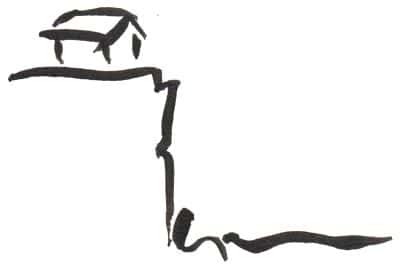
I refined these eleven pieces, added six more, and created a compilation called “Two World Poems.” I’ll publish this as a set of preparatory exercises for readers interested in the interoception book, making it a two-book series. To add an extra dimension, I added illustrations for each poem. Most are passable, but this one was the best:
I started this post by asking how hypnosis and poetry are different? The answer is that hypnosis, as part of hypnotherapy, has a direction. It has a means and a rough idea of an end.
Poetry, on the other hand, stops short of getting anywhere. One could say much the same of most art. I’m not sure that therapy is all that well founded, but it can be held to a standard. In contrast to the arts, which largely rest on a combination of aesthetics and popularity.
Hypnotherapy may lack aesthetic standards and popularity, but those have little effect in the long term. In the end, a work is judged by what it has accomplished.
I prefer those arts that can be held to account, and in this regard hypnosis prevails as the foundation of religion. Does that make it socially useful or just popularly entertaining? As we hear in the field of hypnotherapy, anything that affects your state of mind is a form of hypnosis.
“As with most other ancient Chinese philosophers, Lao-Tzu often explains his ideas by way of paradox, analogy, appropriation of ancient sayings, repetition, symmetry, rhyme, and rhythm.” — Wikipedia (2026)
Enter your email for a FREE 1x/month or a paid 4x/month subscription.
Click the Stream of the Subconscious button.